
A Range Manager's Confession
Range Manager Confesses To Golfers Over 50: “What A 71-Year-Old Member Told Me The Day Before The Tournament Took Apart Four Weeks Of Lessons”
For seventeen years I watched his wrist and never asked what it was. Since I found out, I look at every divot at the club differently.
By Dan Whitaker · Range manager at the club since 2009 · Nov 2026

Mr. Hale, seventy-one, the day before the tournament.
I’ve run the range at a private club for seventeen years. In that time I learned something about divots that nobody ever taught me.
I pick the balls, clean the grooves on the clubs, set up the bays. I know who warms up with wedges and who goes straight to the driver. And I know whose divots start in front of the ball and whose start behind it.
For years I didn’t know why. Then, a month before the member-guest, the strangest list I’ve ever seen landed on my desk, and the last item on it changed what’s in my own bag.
My name is Dan Whitaker
The club is outside Charlotte. A real grass range, members who’ve had the same bay for twenty years. I’m a sixteen handicap, and I have been for twenty years. I’d convinced myself that was my game.
I’d convinced myself the problem was only mine. Meanwhile every morning I watched dozens of members do the same thing.
A day at the range, every day for seventeen years
First hour: the first shots are beautiful. High, clean, like the poster.
Second hour: the first divot behind the ball. Then a thin one. Then the swing thoughts.
Late morning: a member looks at his club as if it were its fault.
Saturday: the same member, the same hole, the same face.
I knew how it would go every time. It never occurred to me that anything could be done about it.
The list
For the tournament, Mr. Doyle, eighteen handicap, more money than patience, had teamed up with a two handicap from another club. The biggest event of the year. A month before, his assistant sent the range a list. At a club like ours you don’t say no to a member at that level. We said yes to everything.
One: his bay rebuilt from scratch. Fresh sod every week, a shade tent, a brass plate with his name on it. For one month.
Two: a tour-level launch monitor, calibrated by a technician who drove down from Atlanta. Nobody else allowed to touch it.
Three: a teaching pro flown in from Florida, three mornings a week, at six. We had a pro forty yards away. He wanted the one from television.
Four: a small box to be left at the range shack. Not for him. For his partner. The name on the lid, nothing else.
I thought it was an insanely expensive list. A brass plate for a month. A launch monitor for a man who couldn’t tell you how far he hit a 7-iron. A teacher on a plane. People who’ve run out of normal things to buy and keep going deeper.

Mr. Doyle’s bay. A month of preparation for one tournament.
The little box bothered me the most. What does a two handicap need that he can’t buy himself?

The little box. His partner’s name on the lid, nothing else.
Meanwhile I’d already tried everything on my own:
- Hours of YouTube, every drill I could find
- New irons, twice
- Lessons with our assistant pro
- A thousand balls a month on this same range
- Moving the ball back, then forward, then back again
- Thinking less. Then thinking more.
None of it lasted past the tenth hole.
Four weeks, every morning the same
I watched Mr. Doyle practice. The Florida teacher had him move the ball back an inch, then forward. Shift your weight. Don’t hang back. Rotate, don’t slide. The monitor told him everything to the decimal. And every morning: fat. Thin. Pure. Fat again.

Mr. Doyle at his bay, week two.
One beautiful shot, and he’d look at the teacher as if he’d finally figured it out. The next one took a divot the size of a dinner plate, four inches behind the ball.

Four inches behind the ball.
I knew that look. I’d worn it myself for twenty years.
The day before the tournament
His partner showed up. Mr. Hale. Seventy-one years old. Hits it pure every single time. He opened the little box, pulled out a thin black wrap and slid it onto his left wrist like he’d done it a thousand times.
I figured he’d hurt it. Then it came to me: the four handicap who plays every Tuesday. The college kid home for the summer. Our assistant pro. Same thing. Same wrist. For years. And I had never asked.
So I asked. “Mr. Hale, did you hurt your wrist?”
He smiled like a man who’d been waiting for someone to ask. “Put one on,” he said. “Hit ten balls. Then you’ll get it.”
“Does everyone know about these?” I asked.
“The guys who stopped flipping do.”
What I saw on my phone
I filmed Mr. Doyle’s swing and slowed the video down, with his permission.

A frame from the slow-motion video.
Top of the backswing, fine. Transition, fine. In the last foot before the ball, his left wrist flipped open. Cupped, like he was trying to help the ball into the air.
One move. When the wrist flips, the bottom of the swing jumps back behind the ball. Catch it early, fat. Catch it on the way up, thin. Catch it just right, pure. That’s why it feels like timing. It is timing: the swing is timing a flip.
No lesson corrects it. It happens faster than anyone can think. Nobody can think their way out of it.
What it is
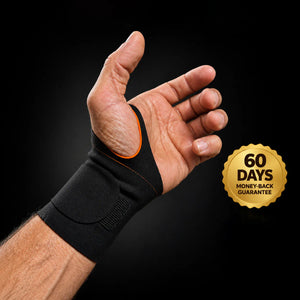
It’s called Outergolf. It sits on the lead wrist and pulls the second the wrist starts to flip. It doesn’t lock anything: the wrist still hinges back. It just doesn’t let the wrist open when it matters.
The next day Mr. Doyle asked me, very quietly, whether there was a spare.
See how it worksThe Monday after the tournament
On Monday the brass plate came off. The tent disappeared. The launch monitor went back to Atlanta. The teacher flew back to Florida.
The wrap stayed on his wrist.
Mine, after that
I bought one. I felt a little stupid buying it. Then I hit ten balls. The click. The divots starting in front of the ball. Somewhere around the tenth I stopped counting.
I showed it to my brother. “What changed,” he said. It wasn’t a question. Then my son-in-law wanted to try it. Then two coworkers.
Why nobody says it
The club companies don’t say it, because a new driver comes out every year and everyone has to believe it’s the answer. The lesson guys don’t say it, because the customer has to come back next week. And the good players don’t say it, because they figured it out so long ago they assume everybody knows.
What’s left
Mr. Doyle’s bay cost a month. This is for every swing.
Try Outergolf risk freeFree shipping. 60-day guarantee.
This is a fictional story used to illustrate how the product works. Names and details are invented.